
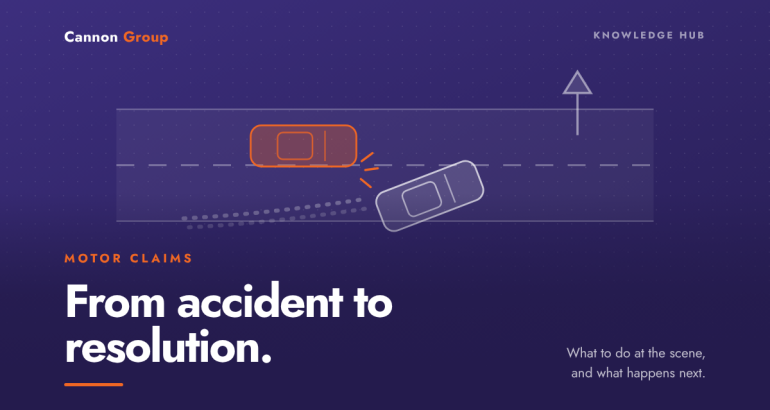
A plain-English guide for Cannon motor policyholders, written for the day you actually need it.
Your part, all of it
- Never admit fault. Not at the scene, not afterwards.
- Report it and photograph it. Police abstract, then call us.
- Forward every letter the day it reaches you.
Our part
- Assess and settle your own claim.
- Negotiate with anyone claiming against you.
- Defend you in court and pay the judgment, up to your limits.
What has happened?
An accident can start two separate processes: your claim to us, and someone else’s claim against you. This guide covers both. Go straight to your situation, you do not need the rest.
What happens the moment it occurs
Five things, while you are still there.
- 1Admit nothingNot at the scene, not on WhatsApp. Even “sorry” counts.1
- 2Photograph it allFive shots matter most. The map below shows which.2
- 3Take namesDrivers, passengers, witnesses. Time and place.3
- 4Police abstractRequired by law. No abstract, no claim.4
- 5Call us today020 396 6000, even if unsure you will claim.5
- 1The point of impactClose up, then a step back.
- 2Your number plateProves which car is yours.
- 3Their number plateThe single most useful photo.
- 4Skid marksThey disappear within hours.
- 5Signs and markingsShows who had right of way.
Photographs settle most arguments about who was where, and they are the fastest way to close a query weeks later. Tell us even if you are not certain you will claim: letting us know early costs nothing and keeps your options open.
What happens if your vehicle is damaged
Six steps. Two are yours, four are ours.
- 1Report itPolice first, then us. Same day.
- 2Send documentsAbstract, photos, claim form, ID, licence.
- 3We assessYour garage or our centre.
- 4We authoriseRepairs, or cash so you arrange them.
- 5We settleRepair authority or a payout voucher.
- 6We recoverWe chase the driver at fault, in your name.
Occasionally the assessment and the reported account do not match. We may come back for clarification, or appoint an investigator. It is a normal verification step rather than an accusation.
Step six is the one people query. The recovery case has to be filed in the name of whoever owned the vehicle, which is you. If you do not help us recover, your policy entitles us to recover that money from you instead. One signature avoids that.
What happens if other people were involved
Any of these can bring a claim against you. They are all third parties.
- The other driver
- Passengers
- Pedestrians
- Riders and pillions
They claim for property
Damage to a vehicle or property. Most motor disputes. Usually settled without court.
They claim for injury
Slower, because medical evidence takes time, and the paperwork is heavier.
Whichever it is, the sequence is the same every time: a demand, then a summons if it is not settled, then court. The next three topics take those one at a time.
What happens if a third party sends a demand
They intend to claim. Nothing has been filed yet, and that is the good news.
You do three things
- Forward it to usThe day it arrives.
- Complete the paperworkWhatever we ask for.
- Pay your excessWe cannot settle until you do.
We do the rest
- Check the fileAgainst your report and the abstract.
- NegotiateWith the third party or their insurer.
- SettleMany claims end here, with no court.
For an injury claim the demand must reach us before a suit is filed, while there is still room to settle. That window is the whole value of this stage.
What happens if you are served with a summons
A case has been filed. A court clock is now running against you.
- By hand
- By email
- Over WhatsApp
- Day 0You are servedHowever it reaches you, the deadline starts that day.
- Same daySend it to usWith the date and the method. That detail becomes proof later.
- ThenWe take it onWhere the policy terms have been kept, we respond for you.
For an injury claim the summons arrives with a bundle: the plaint, a verifying affidavit, medical reports, witness statements and receipts. Forward all of it, not just the top sheet.
What happens if the papers sit in your glove compartment
- 1The deadline passesWe never saw the papers, so nobody answered them.
- 2Judgment is entered against youThe court decides without hearing your side.
- 3The claim may not be payableA policy condition was broken.
- 4The bill becomes yoursIncluding the costs we incur as a result.
What happens if it goes to court
Most matters never get this far.
- KES 1MUpper limit for the Small Claims Court
- 60 daysThe target the law sets to conclude a case
- 0Lawyers needed when it settles by consent
Where liability is contested we appoint an advocate, or for injury claims a law firm, to act for you to the end of the case. Your cooperation is required under the policy.
Smaller disputes are filed on standard forms through the Small Claims Court. The sixty days is a target set by law rather than a guarantee, and the courts have treated it as aspirational, but the route is markedly quicker than the one it replaced.
Words in your letters, in English
- IndemnifyPut you back where you were.
- Police abstractThe police record of the accident.
- ExcessThe share of a claim you carry yourself.
- Cash in lieuWe pay you instead of arranging the repair.
- Third partyAnyone else caught up in the accident.
- SubrogationWe chase whoever caused it, in your name.
- SummonsA court order to answer a claim. It has a deadline.
- PlaintTheir written account of what they want.
- RepudiateA claim declined for a missed condition.
Ask before the deadline, not after
The call costs you nothing.
- Call+254 20 396 6000
- Emailinfo@cannon.co.ke
- Head officeGateway Park, Block D
Mombasa Road, Nairobi
This guide describes the usual claims process in general terms. Your policy wording, limits and conditions govern your cover. Where the two differ, the policy applies. Nothing here is legal advice on a specific case.